







Engineering data quality problems rarely announce themselves as a single failure. A missing unit, outdated revision, or duplicated test record may pass from a field form into a spreadsheet and then a report. By the time the discrepancy becomes visible, teams may no longer know which value is authoritative.
Improving engineering data quality takes more than cleansing. It requires clear definitions, reliable identifiers, well-placed validation, and enough traceability to explain where important records came from and what changed.
What Makes Engineering Data “High Quality”?
Engineering data is high quality when it is fit for the decision, calculation, approval, or operational task it supports. A valid value can still be unusable if its unit, location, or revision is unclear. Quality is contextual, but it should still be evaluated against explicit requirements.
The ISO/IEC 25012 data quality model treats data quality as a set of characteristics that can be specified and evaluated. For engineering teams, four dimensions provide a practical starting point:
| Dimension | Practical test | Engineering example |
|---|---|---|
| Accuracy | Does the value reflect the approved source or observed condition? | A laboratory strength result matches the signed certificate. |
| Completeness | Are the required values and context present? | A field record includes location, date, unit, asset identifier, and status. |
| Consistency | Is the meaning represented the same way across records and systems? | Pressure uses the agreed unit and the same equipment code in every dataset. |
| Traceability | Can a reviewer reconstruct origin, ownership, revision, and transformation? | A reported quantity links back to its source file, calculation rule, and approver. |
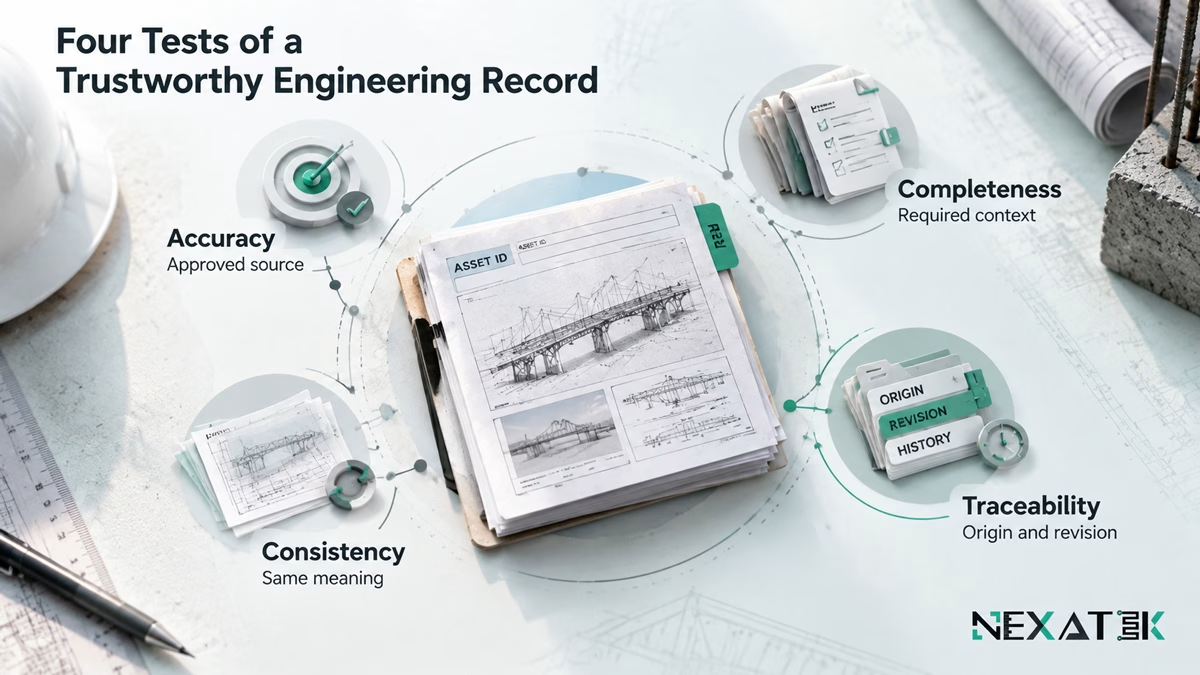
Validation supports all four dimensions. It can test formats, permissible values, identifier patterns, relationships, ranges, and required fields. It cannot decide whether a dataset is fit for purpose until the business and engineering rules are explicit.
Common Engineering Data Quality Problems
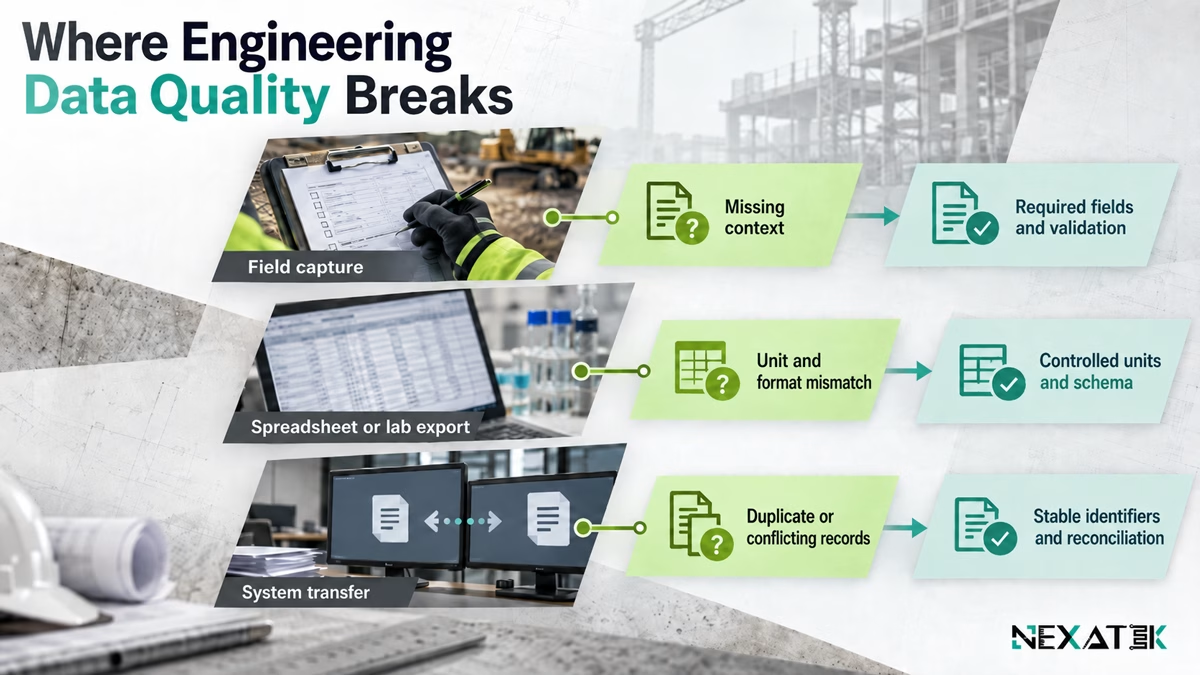
Poor quality is not limited to obviously incorrect numbers. Some of the most consequential engineering data errors concern missing context, conflicting versions, and records that look complete but cannot be trusted.
Missing and Incomplete Data
Blank fields are the simplest form of incomplete data, but missing meaning is more serious. A measurement without a unit, coordinate reference, sampling method, or asset link may be impossible to interpret safely. So may an empty cell that could mean “not measured”, “not applicable”, or “unknown”.
Completeness rules should focus on what a decision needs. For a critical record, the practical minimum often includes an owner, date, unit, status, and a link to the object, location, or activity being described.
Inconsistent Formats and Units
Engineering data consistency breaks when teams record the same concept differently. One source may use MPa while another uses kPa. Dates may switch between regional formats. Asset names may alternate between an official identifier, a shortened label, and a contractor’s local code.
These differences affect joins, calculations, filters, and trends. Conversion requires a known original unit, while identifier mapping requires an agreed authoritative definition.
Duplicate or Conflicting Records
Duplicate engineering data emerges from copied spreadsheets, repeated imports, offline capture, parallel contractor systems, and revised laboratory files. Near duplicates are harder to find because the same event may carry different timestamps, identifiers, spelling, or approval states.
Automatic deletion is unsafe. Teams need a matching rule, trusted source, and controlled method for merging or retaining records. When values conflict, the resolution and reason should remain visible.
Manual Entry and Transfer Errors
Manual transfer introduces transcription mistakes, shifted columns, lost decimals, and altered formulas or formats. Risk rises whenever the same value is retyped between field, laboratory, calculation, and reporting tools.
Automation can reduce rekeying, but only after the receiving structure and validation rules are sound. High-risk handoffs should use controlled imports, field-level checks, exception queues, and reconciliation totals where meaningful.
Why Engineering Data Quality Problems Occur?
Most defects are symptoms of workflow and governance gaps. They persist because local processes evolved faster than shared rules.
Common root causes include:
- unclear ownership for definitions, corrections, and approvals
- multiple spreadsheets or systems acting as the source of truth
- inconsistent master data for assets, locations, materials, and activities
- interfaces that transfer values but drop metadata or revision status
- validation added at reporting time instead of at capture
- uncontrolled formulas, conversions, scripts, and manual transformations
- project handovers that preserve files but not their relationships or context
The ISO 19650 information management framework addresses controlled exchange, recording, versioning, and organisation across built asset information. In practice, building an engineering data strategy connects those principles to decisions, workflows, owners, and systems.
How to Assess Engineering Data Quality?
Start with data that influences a material decision. Select critical elements such as asset identifiers, test results, design parameters, inspection outcomes, or certified quantities. For each, define the accepted source, unit, format, range, status, and relationships.
Then profile the actual data against those rules. Useful measures include:
- completeness rate for mandatory fields and contextual metadata
- validity rate for formats, units, permitted values, and engineering ranges
- duplicate rate based on stable identifiers and carefully selected matching keys
- consistency rate across systems that represent the same object or event
- traceability rate for records linked to a source, owner, revision, and approval
- timeliness against the point when the record becomes necessary for work or review
Do not rely on one average score. A dataset can appear highly complete even when the missing fields determine location, safety classification, or acceptance. Report quality by critical element and workflow, then inspect sample evidence chains.
Finish with a prioritised defect register covering the affected decision, root cause, owner, control gap, action, and residual risk. This turns concern about inaccurate engineering data into a manageable improvement backlog.
Find the data defects that affect engineering decisions
NEXATEK can help map critical data flows, define quality rules, and identify where missing context, duplicate records, or uncontrolled transfers create operational risk.
How to Improve Data Quality Systematically?
A sustainable data quality framework controls new records while resolving existing defects. The following sequence keeps the work tied to engineering value.
- Prioritise critical decisions and data. Identify where unreliable information can change a design choice, approval, quantity, safety assessment, maintenance action, or contractual position. Begin with one bounded workflow.
- Assign ownership and an authoritative source. Name who defines and corrects each critical element, and which system or controlled record prevails when values conflict.
- Standardise identifiers, units, and metadata. Establish controlled values for assets, locations, materials, test types, and statuses. Preserve original values and units during conversion, with enough metadata to explain the record outside its source application.
- Validate at capture and at interfaces. Apply required fields, permissible values, range checks, relationship checks, and duplicate warnings near creation. Repeat critical checks after import, transformation, or synchronisation.
- Remediate with an auditable decision trail. Quarantine questionable records and merge duplicates only under approved rules. Record what changed, why, who approved it, and which outputs need refreshing.
- Monitor the process, not just the backlog. Track defects by source and rule, review recurring exceptions, and change the workflow that creates them. Pilot controls, then extend them when ownership and results are stable.
Where fragmented spreadsheets or document folders cannot maintain stable relationships, structured engineering data infrastructure can support controlled identifiers, validation, metadata, access, and version history. Technology is useful only when the underlying definitions and responsibilities are agreed.
Fix the point of creation before cleaning the archiveHistorical remediation has value, but it will not hold if the same workflow keeps producing defects. A quality programme should pair each correction rule with a preventive control at capture, transfer, or approval.
How Better Data Supports Analytics, Automation and AI?
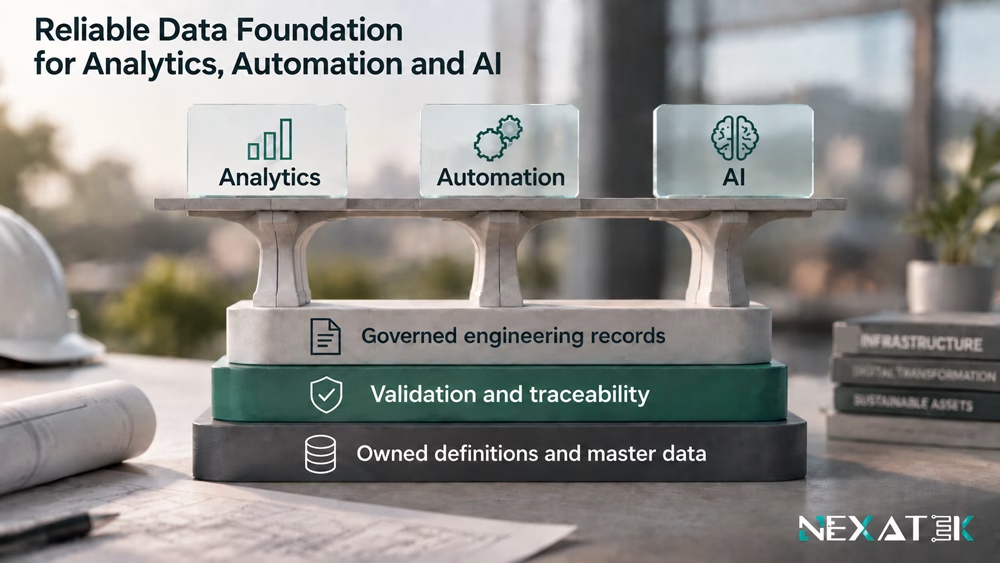
Analytics, automation, and AI amplify their inputs. Complete, consistent, and traceable records let teams compare like with like, reproduce calculations, and investigate anomalies without rebuilding the dataset. This creates a stronger base for reliable engineering analytics.
Workflow Automation in Engineering becomes safer because rules can act on stable identifiers and known states. For AI use, provenance and context help teams judge whether source material is relevant, current, and suitable.
Better data does not remove the need for engineering review; it makes that review more focused. Experts can spend less time reconciling files and more time examining assumptions, unusual conditions, and the consequences of a decision.
Key Takeaways
- Engineering data quality depends on accuracy, completeness, consistency, and traceability in the context of a real decision.
- Missing metadata, inconsistent units, near duplicates, and manual transfers can be as damaging as an incorrect value.
- Assessment should focus on critical data elements and evidence chains rather than one average quality score.
- Sustainable improvement combines ownership, master data, validation, controlled remediation, and ongoing monitoring.
- Reliable records provide the foundation for analytics, automation, and AI, but they do not replace engineering judgement.
Conclusion
Engineering data becomes trustworthy when quality is designed into the workflow. The practical path is to identify the decisions that matter, define the records they depend on, measure defects against explicit rules, and correct both the data and the process that produced it.
That approach turns data quality management in engineering from periodic clean-up into a controlled capability. It also makes future integration, reporting, automation, and AI initiatives easier to govern because the underlying information retains its meaning.
Build confidence into every critical engineering record
NEXATEK can help you assess engineering data quality, trace root causes, and design practical controls that fit field, laboratory, design, and reporting workflows.
Frequently Asked Questions
What is engineering data quality?
Engineering data quality is the degree to which data is accurate, complete, consistent, traceable, and fit for the engineering decision or process it supports.
How can engineering data quality be measured?
Measure critical elements against defined rules for completeness, validity, uniqueness, consistency, traceability, and timeliness, then report results by workflow and risk rather than relying only on an overall average.
What causes poor engineering data quality?
Common causes include unclear ownership, uncontrolled spreadsheets, inconsistent identifiers and units, missing metadata, duplicate systems, manual transfer, weak interface controls, and transformations that are not documented or validated.
How can engineering data errors be prevented?
Prevent errors by standardising definitions, validating records at capture and transfer, reducing rekeying, controlling revisions, assigning owners, and monitoring recurring exceptions so their root causes are removed.




Good point about fixing data quality at the source instead of dealing with it later!
Exactly, James! Fixing data quality at the source is usually much more effective than cleaning the same issues later. That’s also why validation rules and a well-structured database matter so much in custom database development. Which data quality issue do you see most often in engineering teams?