







Digital transformation becomes a strategy problem when several worthwhile initiatives compete for the same budget, data, and management attention. A field application, BIM environment, dashboard, AI assistant, and enterprise platform can each improve one area while the combined portfolio remains fragmented. A digital transformation strategy for civil engineering companies connects investment to current workflows, data, capabilities, governance, and defined engineering and business outcomes.
The strategic question is not which technology comes next. It is which operating problems should change, what capabilities are required, who owns the change, and how success will be judged.
What Is a Digital Transformation Strategy in Civil Engineering?
A digital transformation strategy in civil engineering is a company-level plan for using digital capabilities to improve how engineering work is delivered, controlled, measured, and reused. It links business objectives with process, data, technology, roles, and governance.
This differs from technology adoption. A new platform, BIM deployment, or AI assistant is an initiative. Strategy explains why it exists, what data and process dependencies it has, who owns it, and which outcome justifies continuing it. The Institution of Civil Engineers similarly frames technology as an enabler rather than the end goal of transformation.
| Technology adoption | Digital transformation strategy |
|---|---|
| Starts with a tool or platform | Starts with an operating or business objective |
| Measures deployment and usage | Measures operational and engineering outcomes |
| Often sits within one function | Coordinates data, process, systems, and organisational capability |
| Can succeed as an isolated project | Must remain coherent across a portfolio of initiatives |
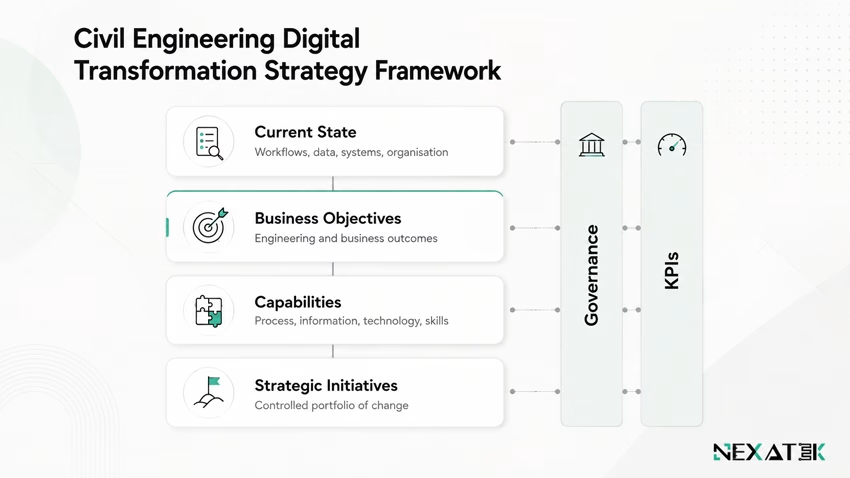
Strategy should guide investment without becoming a detailed delivery roadmap. The roadmap comes later. Strategy defines the destination, capability gaps, principles, and rules used to judge initiatives.
Why Civil Engineering Companies Need a Structured Digital Strategy?
Civil engineering organisations have a structural reason to avoid isolated technology decisions. Work is distributed across projects, disciplines, offices, sites, suppliers, and specialist applications. Design assumptions change, approvals iterate, field conditions create exceptions, and project records must remain traceable.
A new tool can improve one task while increasing complexity elsewhere. A field application may accelerate inspection capture but create a reporting problem if its asset IDs do not match the enterprise database. A dashboard may speed reporting while hiding manual reconciliation underneath. Strategy tests these relationships before local gains become long-term integration debt.
Research also shows why technology alone is insufficient. A 2024 construction-sector study identified business strategy, leadership, employee development, cloud services, and organisational innovation among factors affecting transformation. Research on integrated digital delivery also highlights skill gaps, interoperability, technical complexity, and organisational constraints. A credible strategy must therefore treat organisational readiness and information structure as seriously as software selection.
Core Components of a Civil Engineering Digital Transformation Strategy
A practical engineering digital transformation framework connects desired outcomes, current operating maturity, and the capabilities required to close the gap. Governance and measurement keep those layers aligned.
Business Goals and Transformation Objectives
Start with business and engineering outcomes that leaders can recognise in daily operations. Objectives may include shorter technical approvals, less repeated site-to-office data entry, better revision traceability, more reliable project reporting, or earlier use of sustainability data.
Objectives must be specific enough to influence choices. “Become more digital” cannot distinguish a useful initiative from a fashionable one. “Reduce manual reconciliation between field progress and monthly reporting” points directly to the process, data owners, systems, and evidence that need assessment.
Digital Maturity and Current-State Assessment
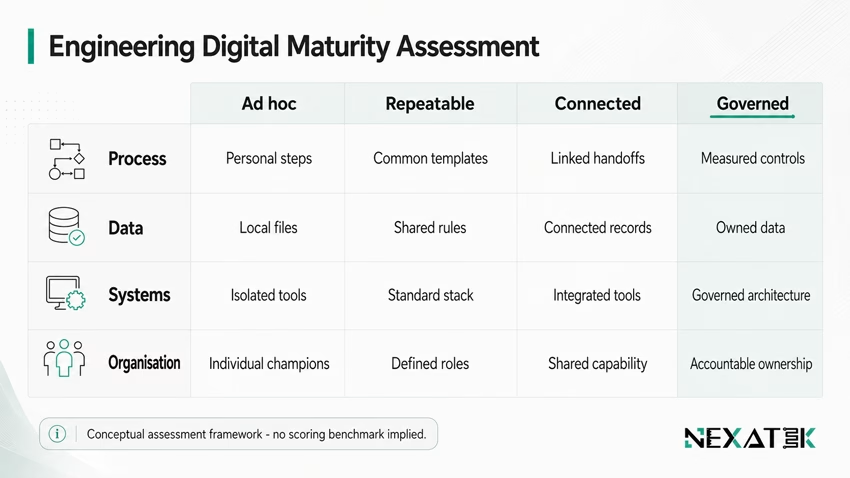
Digital maturity should be assessed across the operating model, not reduced to a software-licence score. A useful current-state assessment examines how work moves, where data is duplicated, which systems are authoritative, how exceptions are handled, and whether teams have the skills and ownership to sustain change.
For civil engineering firms, four dimensions usually deserve separate attention:
- Process: handoffs, reviews, approvals, rework, exceptions, and informal workarounds.
- Data: ownership, identifiers, quality, revision history, access, and reuse across projects.
- Systems: specialist engineering tools, enterprise platforms, integrations, spreadsheets, and legacy applications.
- Organisation: roles, decision rights, digital skills, training capacity, support, and change ownership.
The assessment should expose constraints that change strategic choices. Inconsistent project identifiers can make advanced analytics premature. Low-connectivity field conditions can make a cloud-only workflow operationally unsuitable even when the software performs well in a demonstration.
Data, Technology, and Process Capabilities
Capabilities describe what the organisation must be able to do repeatedly, not which vendor product it owns. Needs may include reliable master project data, controlled revisions, role-based approvals, offline field capture, automated reporting, system integration, or consistent carbon-data structures.
Technology choices then become relevant, but remain subordinate to the capability. BIM can strengthen model-based coordination and information management. The ISO 19650-1 framework covers exchanging, recording, versioning, and organising built-asset information. AI and engineering analytics can support search, classification, prediction, or decision support. None removes the need for clear information ownership and review responsibility.
NEXATEK
Define the capability before selecting the platform
A platform decision is easier to defend when the required engineering capability is already clear. Define the process, the information that moves through it, its owner, its exceptions, and the decision it supports. Software can then be evaluated against the operating requirement instead of becoming the requirement itself.
How to Develop a Digital Transformation Strategy?
Move from evidence about the current operating model to a controlled set of strategic choices. Stop before the strategy becomes a project-by-project implementation roadmap.
Assess the Current State
Map representative workflows end to end, such as design review, field reporting, document control, project reporting, procurement handoffs, or sustainability data. Record systems, spreadsheets, duplicated entries, approval points, data owners, exception paths, and current performance measures.
Establish baselines at the same time. Approval time, reporting effort, duplicate entry, record completeness, retrieval time, and rework can later show whether an initiative changed the process. NEXATEK’s engineering workflow optimization service follows this process-first view of digitalisation.
Review the workflow before defining the technology programme
A focused assessment can show where fragmented data, repeated handoffs, and unclear ownership are limiting the current operating model.
Define the Future State
The future state should describe how the organisation needs to work, not how a future interface should look. Define principles for data ownership, system responsibility, approvals, integration, security, access, and reporting. Decide which information needs one authoritative source and where specialist tools should remain independent but connected.
A consultancy may prioritise traceable calculations and reusable knowledge. A contractor may focus on field-to-office flow and project controls. A manufacturer may need product data, calculations, submissions, and customer access to work as one system.
Identify Strategic Digital Initiatives
Once capability gaps are visible, define strategic digital initiatives. Examples include a governed engineering data foundation, modernised field workflows, ERP and project-system integration, a customer portal, automated technical reporting, carbon-data infrastructure, or controlled AI-assisted knowledge access.
Each initiative needs a direct line back to an objective and a known dependency. Analytics may depend on consistent project data. Workflow automation may depend on defined approval ownership. NEXATEK’s custom enterprise technology solutions are relevant when several dependencies must be coordinated across departments and engineering records.
The portfolio does not need to start at once. A measurable pilot can test operating assumptions before broader rollout.
Define Governance and Success Metrics
Governance makes transformation an operating responsibility rather than an IT project. Each initiative needs an accountable business owner, technical and data ownership, decision rights, review gates, and a method for resolving exceptions. Governance should also decide when an initiative is expanded, revised, paused, or stopped.
Select metrics at the same time. Usage statistics do not prove transformation. A field application can have high login rates and still add reporting effort. Measure operational results alongside adoption and keep baselines stable enough for comparison.
NEXATEK
Governance should control evidence, not just budgets
A steering group should be able to ask what changed in the workflow, whether data quality improved, where users still bypass the process, and whether the initiative produced the intended engineering or business outcome. Those questions are more useful than checking whether the software went live on schedule.
Common Strategic Mistakes to Avoid
The most damaging mistakes disconnect technology from the operating model:
- Starting with a product shortlist. Features receive attention before capability gaps are defined.
- Treating every pain point as a software problem. Some failures come from unclear responsibility, duplicate approval, or poor data definitions.
- Integrating systems before defining data ownership. Connection can move conflicting records faster without creating one reliable source.
- Making transformation an IT-only responsibility. Engineering, operations, project management, and leadership must own outcome decisions.
- Measuring only adoption. Logins and deployment milestones need outcome measures such as cycle time, data quality, rework, decision speed, or reporting effort.
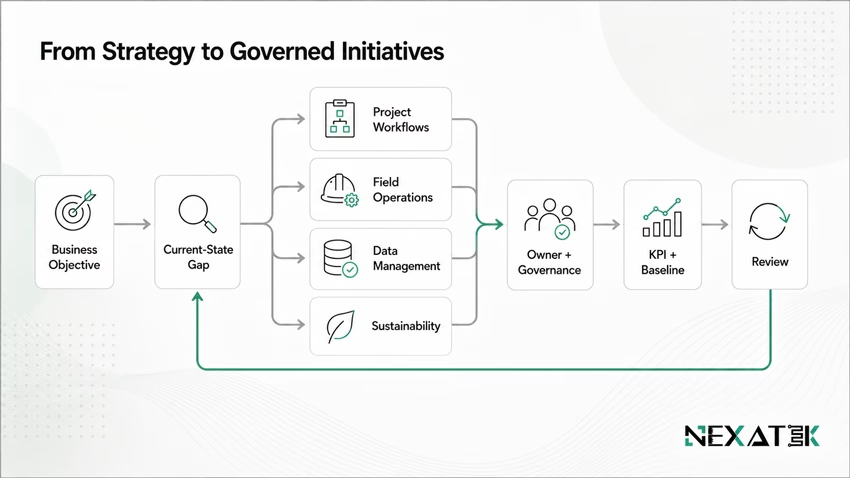
Every initiative should remain traceable to an objective, capability gap, owner, baseline, and review decision.
Measuring the Success of a Digital Transformation Strategy
Measure success as a portfolio of operating changes, not as one transformation score. KPIs depend on the objectives, but four views are usually useful.
| Measurement area | Example signals | What it tests |
|---|---|---|
| Workflow performance | approval time, handoffs, reporting effort, rework | whether the process actually improved |
| Data quality and control | completeness, duplicate records, revision traceability, retrieval time | whether information became more reliable |
| Adoption and governance | active use, exception rates, training coverage, unresolved ownership | whether the changed operating model is being sustained |
| Engineering and business outcomes | decision speed, project visibility, calculation consistency, sustainability reporting quality | whether digital capability supports the original objective |
Reviewing the measures together prevents false positives. Strong adoption can coexist with weak data quality. Strategy reviews should use the evidence to decide what to scale, correct, pause, or stop.
Key Takeaways
- Start with engineering and business outcomes, not a technology catalogue.
- Assess process, data, systems, and organisational capability separately.
- Treat BIM, AI, analytics, platforms, and automation as capabilities tied to operating needs.
- Define data ownership and process logic before major integration or automation.
- Give initiatives accountable owners, governance, baselines, and outcome-focused KPIs.
- Use the roadmap later to sequence the strategy, not to replace strategic decisions.
Conclusion
A useful digital transformation strategy gives civil engineering leaders a decision system for change. It connects business priorities to real workflows, identifies data and system constraints, defines required capabilities, and creates governance for choosing and reviewing initiatives.
The harder problem is not finding digital tools. It is coordinating them around engineering information and operating responsibility. NEXATEK’s digitalization services for engineering companies starts from that operating logic so technology choices can follow a defined purpose.
Turn separate digital initiatives into one engineering strategy
NEXATEK can assess current workflows, data, systems, and operating constraints, then help define a transformation strategy that connects digital investment to measurable engineering and business priorities.
Frequently Asked Questions
What is digital transformation in civil engineering?
Digital transformation in civil engineering is the structured use of technology, data, and changed processes to improve how engineering work is delivered, controlled, and reused.
What are the main components of a digital transformation strategy?
A strong strategy connects business objectives, digital maturity, data and process capabilities, technology needs, initiatives, governance, ownership, and success criteria.
How long does a digital transformation strategy take to implement?
There is no universal duration because initiatives have different dependencies and maturity requirements. Separate strategy definition from the later roadmap and implementation schedule.
How should engineering companies measure digital transformation success?
Measure adoption and operating outcomes against baselines such as workflow time, reporting effort, data quality, traceability, rework, and decision speed.




A well-structured digital transformation strategy can prevent engineering companies from investing in disconnected tools that solve only isolated problems. Aligning technology with workflows, data ownership, governance, and measurable business outcomes is what makes digital transformation sustainable.
Really interesting take!
Digital transformation is changing the game for engineering
Absolutely. In civil engineering, the biggest shift is not just adopting new tools, but connecting data, workflows, and decision-making in a more structured way. That’s where digital transformation can create real operational value.