







Custom software development cost in 2026 cannot be reduced to one price per screen, feature, or developer day. An engineering platform may need calculation logic, controlled revisions, project data migration, role-based access, integrations, audit records, and long-term support. Two proposals can therefore describe the same visible interface while carrying very different technical obligations.
This guide gives CTOs, engineering leaders, project managers, and infrastructure planners a practical way to challenge estimates. It separates first-release cost from total cost of ownership, explains the main pricing models, and provides transparent example ranges. The figures are planning benchmarks, not quotations. A reliable budget still begins with workflow analysis and a defined delivery boundary.
What Determines Custom Software Development Cost in 2026?
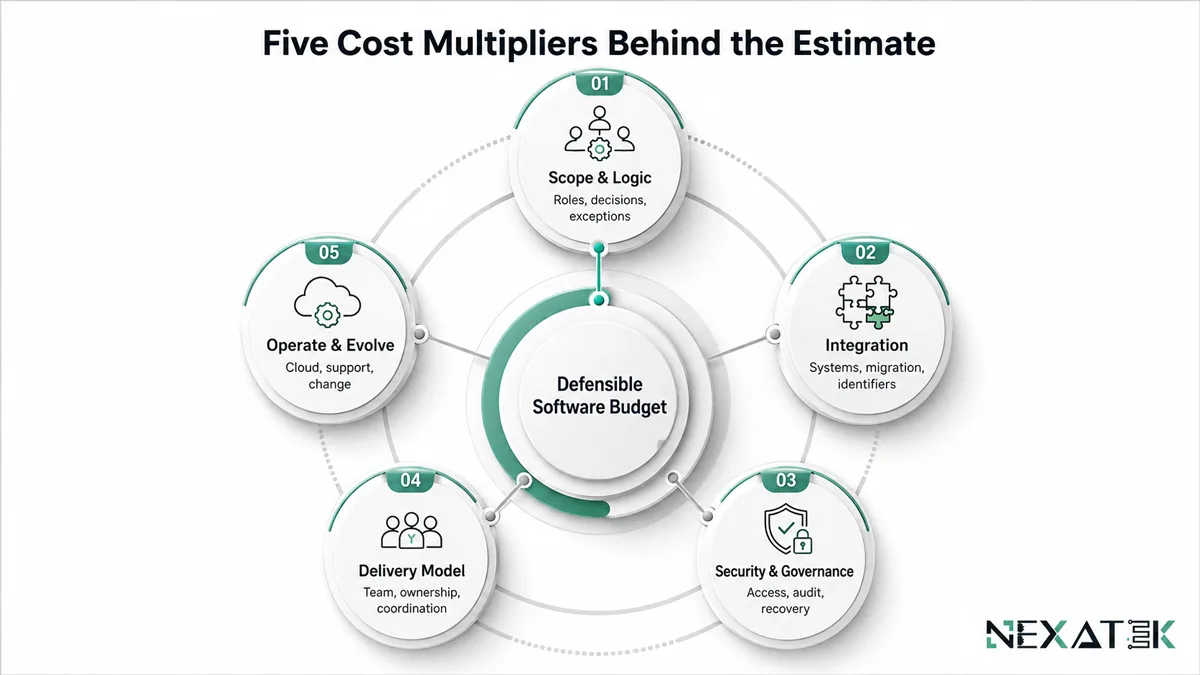
Four cost multipliers usually explain most of the variation between credible proposals: scope and decision logic, integration, security and governance, delivery model, and the effort required to operate and evolve the system. The visible interface is only one part of the estimate. A simple dashboard can sit above a difficult data model, while a complex-looking calculator can remain affordable when its inputs and rules are already controlled.
1. Scope & Complexity of Features
Scope means more than a feature count. The estimate must describe user roles, engineering decisions, exceptions, approval stages, outputs, and the data created at each step. A browser-based calculator with ten screens may be expensive if it embeds proprietary design logic and produces audit-ready reports. A larger portal may cost less when it mainly displays records from a well-structured database.
Separate mandatory workflow from convenience. The first release should solve one measurable problem, such as reducing duplicate entry in inspection reporting or controlling one technical approval cycle. Optional dashboards, advanced search, and secondary integrations can follow after users validate the core process. NEXATEK applies this process-first approach within its custom software development for civil engineering work.
2. Integration with Legacy & Digital Ecosystem
Integration cost depends on the condition of the systems being connected. A documented API with stable identifiers is different from a legacy database with duplicate project codes and no clear owner. The estimate should cover interface design, authentication, field mapping, error handling, monitoring, testing, and the reconciliation of failed transactions.
Migration deserves its own work package. Old spreadsheets and shared drives may contain inconsistent naming, missing metadata, and records that cannot be matched automatically. A project manager who expected a direct import may discover that engineering staff must first decide which version is authoritative. Custom database development often becomes the foundation because integration cannot create reliable data from conflicting source records.
3. Security, Compliance & Data Governance Requirements
Security requirements affect architecture, testing, hosting, and operating cost. Role-based access, audit logs, encryption, backup, recovery, data retention, and incident response should be defined before the team estimates the platform. The relevant controls depend on the information involved, the deployment region, client obligations, and whether the software supports regulated decisions.
Quality requirements should be explicit. ISO/IEC 25010:2023 provides a product quality model that can help teams discuss performance efficiency, reliability, security, maintainability, compatibility, and other quality characteristics. These qualities are not free additions after coding. They influence design choices and the evidence required before release.
4. Delivery Model (In-House, Outsourced, Hybrid)
An in-house team provides direct control but carries recruitment, management, tools, leave cover, and retention costs. Outsourcing converts much of that capacity into a contracted rate, although the buyer still needs a product owner and technical decision-makers. A hybrid model can retain workflow ownership internally while using an external team for architecture, UX, development, testing, or specialist AI work.
Location affects rates, but coordination quality affects total effort. Time-zone gaps, unclear acceptance criteria, and weak engineering context create rework. A lower hourly rate can therefore produce a higher final invoice. The 2026 Accelerance guide explicitly warns that hourly rates do not equal real cost and places team maturity, AI productivity, governance, and delivery quality inside the cost decision.
NEXATEK Perspective
A defensible estimate starts with decisions, data, exceptions, and approval paths. A feature list alone cannot show how much engineering logic, migration work, or governance the system must carry.
Cost Components Breakdown
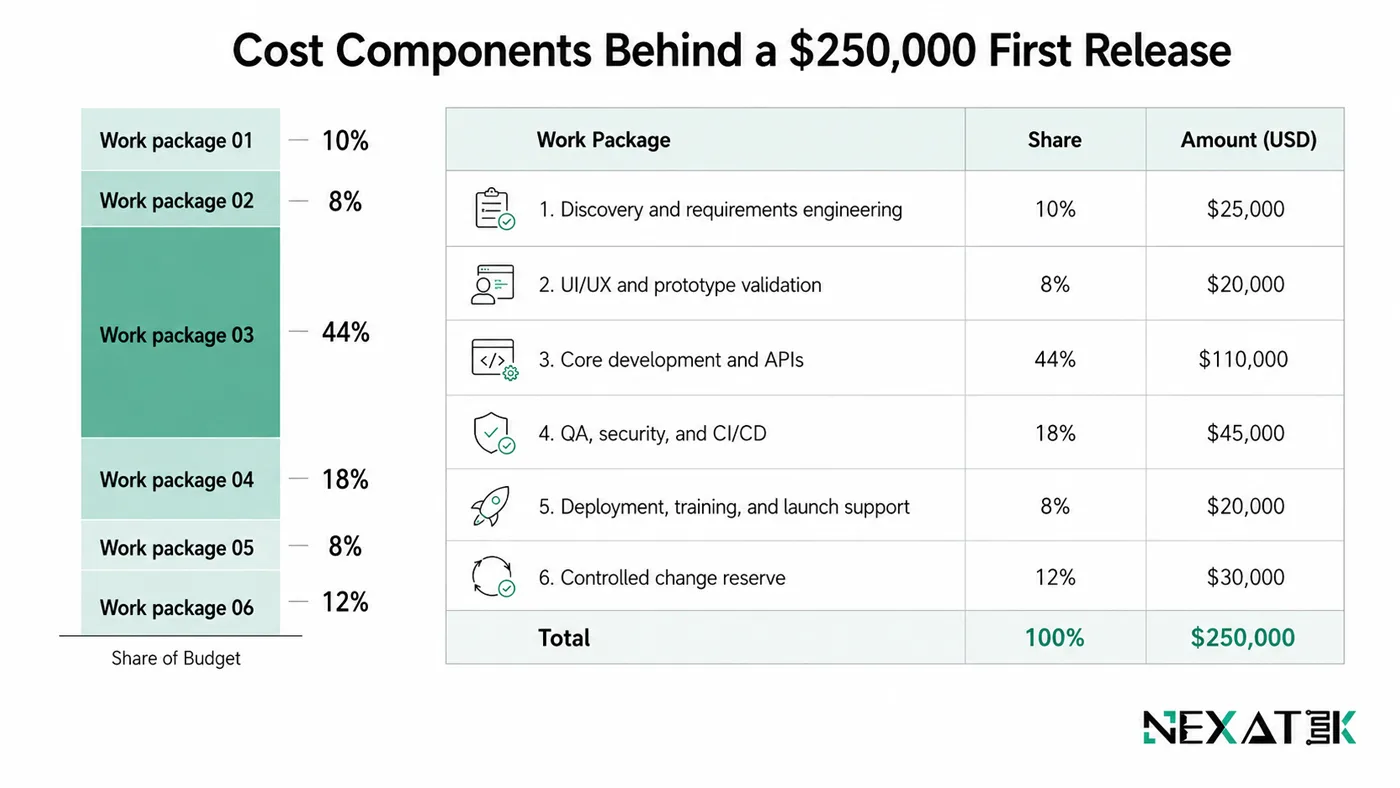
A defensible budget protects discovery, testing, deployment, and controlled change instead of treating coding as the entire project. The following allocation shows one illustrative $250,000 first release. It is not a universal ratio. The percentages should move when a project has unusual migration, compliance, AI, hardware, or integration demands.
Discovery & Requirements Engineering
Discovery maps the current workflow, target workflow, users, data sources, exceptions, and measurable outcome. It also identifies what should not be built. For engineering organisations, this work must include calculations, technical records, revisions, approval responsibilities, and the relationship between documents and structured data.
The output should support estimation: process maps, prioritised requirements, a data inventory, integration assumptions, non-functional requirements, and an initial release boundary. Skipping discovery does not remove its cost. It transfers the work into development, where every unresolved question interrupts coding and increases change.
UI/UX + Prototyping
UX work tests whether the proposed workflow is usable by the people who will maintain its data. A prototype should show realistic tasks, such as submitting an inspection, reviewing a calculation, finding the current drawing revision, or approving a report. Generic screens with ideal data do not expose the difficult parts.
Prototype validation is particularly important for mixed digital maturity teams. Early feedback can remove unnecessary steps before they become coded dependencies. The budget should cover user flows, interface states, validation messages, responsive behaviour, and accessibility where required, not only visual styling.
Core Development & APIs
Core development includes the application logic, database behaviour, user management, reporting, notifications, APIs, and administrative controls. The cost rises when the system must preserve traceability between assumptions, inputs, outputs, approvals, and revisions. Engineering software often needs structured relationships that generic business applications can ignore.
API work should cover contracts and failure conditions, not only successful data exchange. Each integration needs ownership, versioning, security, monitoring, retries, and a method for reconciling disputed records. A connector that works during a demonstration but cannot explain failed transfers is not production-ready.
AI / Machine Learning Module Development
AI cost starts with the use case and the evidence needed to trust the output. A document search assistant may require content preparation, permissions, retrieval evaluation, prompt controls, model selection, and usage monitoring. A predictive model may require labelled historical data, feature engineering, validation, drift monitoring, and a fallback process when confidence is low.
Model fees are only one line. The larger cost may sit in data preparation, human review, security, evaluation, and integration with the engineering workflow. AI should not be used to hide an undefined decision process. It should support a controlled task with a named owner
and measurable acceptance criteria.
IoT / Digital Twin Connectivity Costs
IoT and digital twin projects combine software with physical data sources. The estimate may include sensors, gateways, connectivity, data ingestion, time-series storage, device identity, calibration records, alert logic, and visualisation. Field conditions add practical requirements such as intermittent connectivity and delayed synchronisation.
A pilot should prove one data chain from source to decision. Connecting every available device before checking data quality creates volume without value. The budget should also distinguish the digital representation from the operational workflow that uses it. A model that displays live readings but cannot trigger a governed response remains a visual layer, not a working system.
Testing, QA & Continuous Delivery Pipelines
Testing should cover business rules, integrations, permissions, data migration, performance, recovery, and user acceptance. Automated tests reduce regression risk, but they need maintenance as requirements change. CI/CD pipelines add repeatability by controlling builds, checks, releases, and environment configuration.
Engineering applications need test cases that reflect real records and exceptions. A calculation module should be checked against known results. A document workflow should test rejected, revised, and withdrawn states, not only approval. Security testing and backup recovery should be budgeted as deliverables with evidence, not assumed to happen inside general QA.
Deployment & Licensing
Deployment cost depends on the hosting model, environments, network controls, identity provider, monitoring, and operational handover. Cloud deployment shifts much infrastructure spending into recurring operating expense. On-premise deployment can require hardware, internal administration, patching, and capacity planning. Hybrid arrangements carry both integration and governance overhead.
Licensing may include cloud services, databases, observability, maps, document processing, AI models, security tools, or third-party engineering components. The estimate should state which fees are included, which are usage-based, and who owns each account. Training, operating instructions, and named support responsibilities complete the launch package.
Review the workflow before approving the build budget
NEXATEK can help define the engineering workflow, data ownership, integrations, and first-release scope that a credible estimate requires.
Pricing Models in Custom Software Development
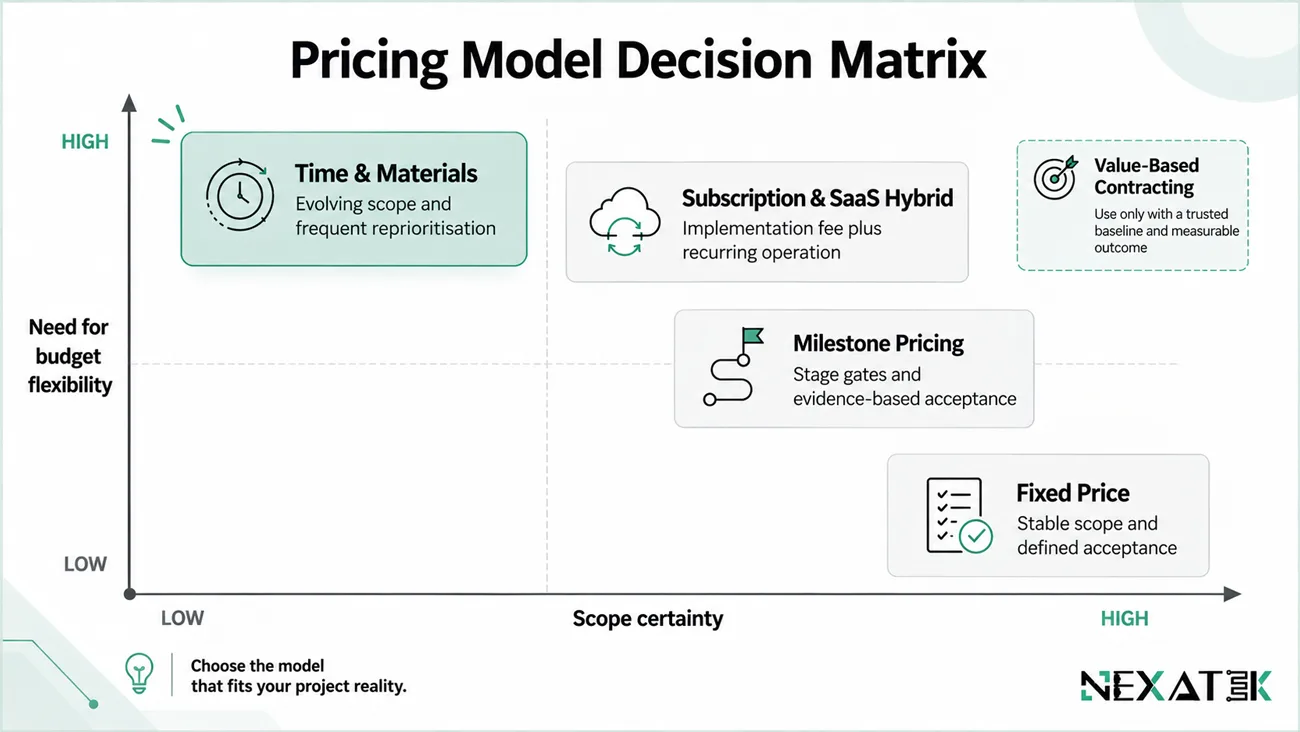
Pricing models allocate uncertainty between the buyer and delivery team. No model removes uncertainty. The right choice depends on how stable the requirements are, how frequently priorities may change, and how much evidence the buyer needs during delivery. A proposal should explain its assumptions, exclusions, acceptance process, and change mechanism alongside the headline price.
Time & Materials
Time and materials suits discovery-led or complex work where requirements will develop through testing. The buyer pays for actual team time and can change priorities between iterations. This flexibility needs budget controls: a prioritised backlog, sprint goals, burn reports, acceptance records, and a forecast to the next decision point.
T&M is not a licence for an open-ended project. It works best when each sprint produces evidence and management can stop, continue, or redirect the work. The contract should define rates, roles, reporting, invoicing units, and the treatment of rework.
Fixed Price vs. Milestone Pricing
Fixed price is suitable when scope, interfaces, data, and acceptance criteria are mature. The supplier prices delivery risk into the proposal and protects the boundary through formal change control. Buyers gain a firm commitment, but late learning becomes expensive because it enters as a variation.
Milestone pricing divides a larger programme into accepted outcomes, such as validated prototype, migration rehearsal, pilot release, and production launch. It can offer more control than one fixed total because each stage provides a review point. Milestones should be tied to evidence, not only calendar dates or percentage completion.
Subscription & SaaS Hybrid Models
A subscription model spreads access, hosting, maintenance, and support across recurring fees. A hybrid contract may charge an implementation fee for configuration and integration, followed by a monthly or annual platform fee. This can reduce first-year capital demand, although long-term cost depends on users, usage, data volume, support level, and contract terms.
Buyers should model exit and portability. The agreement needs clear ownership of project data, configuration, custom logic, and export formats. A low entry price can become expensive when usage grows or when moving the data requires a separate project.
Value-Based Contracting
Value-based contracting links part of the fee to an agreed operational outcome, such as a shorter approval cycle or fewer manual entries. It requires a reliable baseline, measurement rules, and a clear boundary between the software effect and other organisational changes.
This model is difficult when benefits are indirect or arrive over several years. It can work for a defined workflow with trusted metrics and enough transaction volume. It should not replace a technical scope. The parties still need to define quality, security, ownership, and acceptance.
Engineering Consideration
The cheapest proposal is not always the lowest-cost delivery model. Rework, delayed decisions, weak documentation, and unsuitable data structures can consume more budget than the hourly-rate difference between two teams.
2026 Market Benchmarks (With Example Ranges)
Current marketplace data shows why a single global average is weak. Clutch reports that reviewed software projects commonly fall between $10,000 and $49,999, while its average reviewed project cost is $132,480.29 and the usual timeline is about 13 months. It also reports common company rates of $25 to $49 per hour, with country listings ranging from $25 to $49 in India and Ukraine to $100 to $149 in Canada and Australia.
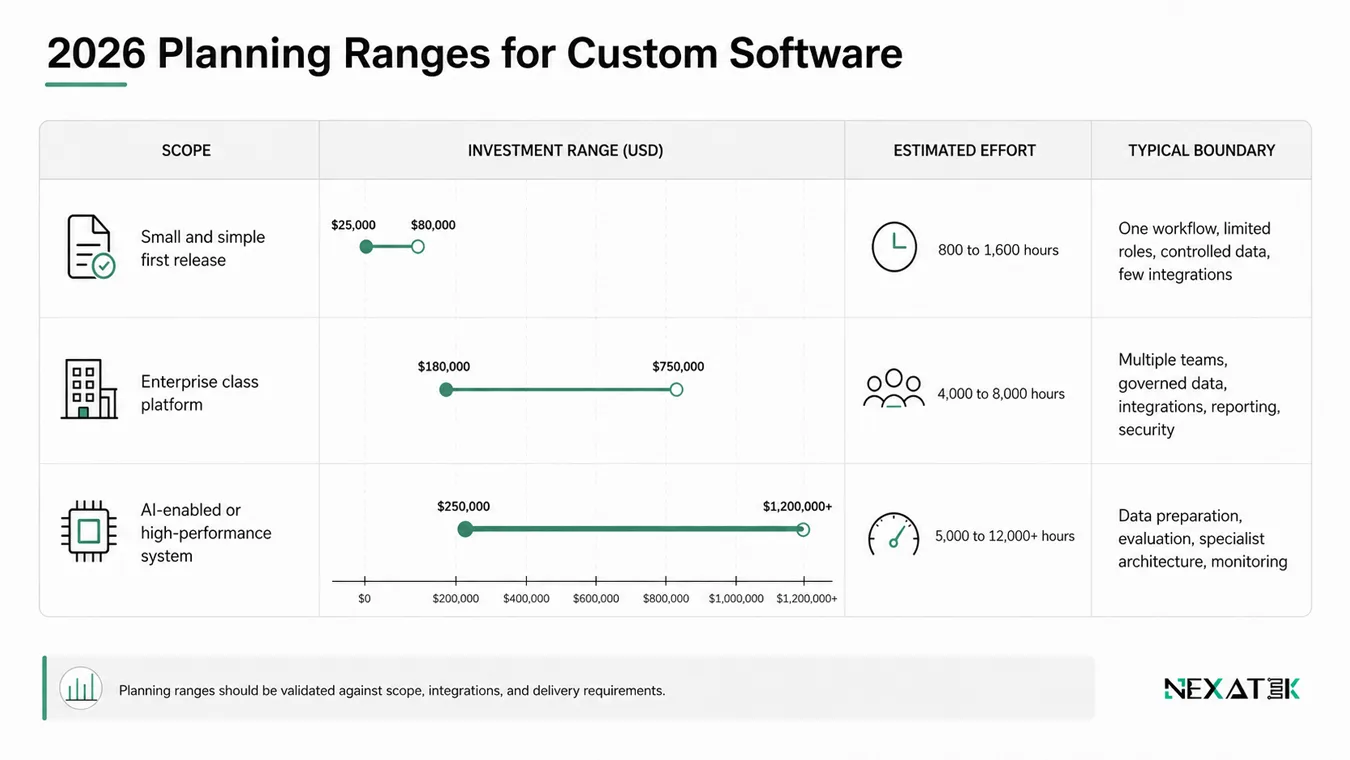
The following ranges are NEXATEK planning examples, not published market averages or vendor quotes. They combine transparent effort bands with current public rate evidence. Engineering workflow complexity, data quality, integration, assurance, and delivery ownership can move a project outside them.
Small & Simple Apps
A small application should have a narrow operating boundary. Examples include one online engineering calculator, one internal approval workflow, or a first-release customer portal using an existing clean data source. The range assumes limited user roles, standard authentication, modest reporting, and no major migration.
Simple does not mean unimportant. A small tool may still need rigorous calculation validation or traceability. The budget stays controlled when the organisation can provide a named product owner, documented rules, realistic test records, and timely decisions.
Enterprise Class Platforms
Enterprise platforms connect several departments, projects, or data sources. They may include role-based access, master data, document and revision control, dashboards, integrations, migration, audit history, and multi-environment deployment. The cost reflects coordination and assurance as much as code volume.
A credible estimate usually arrives in stages. Discovery defines the target operating model. Architecture and prototype work reduce uncertainty. A pilot proves one high-value process before the programme scales. Attempting to fix scope, schedule, and price for the entire enterprise platform before these stages often produces a large contingency or a fragile promise.
AI-Enabled & High-Performance Systems
AI-enabled systems need data and evaluation work that standard applications may not require. Costs rise when the solution handles sensitive knowledge, must cite source records, supports regulated decisions, or needs low-latency inference at scale. High-performance systems also require capacity testing, observability, and architecture that can handle peak demand.
The 2025 DORA report found near-universal AI use among respondents, with 90% using AI at work and more than 80% reporting productivity improvement. It also found continuing concerns about trust and a negative relationship with delivery stability. AI can shorten some tasks, but quality and governance remain budget items.
Regional Cost Variations (North America | EMEA | APAC)
Regional rate differences remain visible. Clutch’s July 2026 listings show $50 to $99 per hour for the United States and Poland, $100 to $149 for Canada and Australia, and $25 to $49 for India, the Philippines, Ukraine, Spain, and Mexico. These directory bands should not be mistaken for a full team cost model.
North America often carries higher commercial rates and easier time-zone access for US buyers. EMEA spans high-cost Western markets and competitive Central and Eastern European delivery. APAC includes a wide range of mature and emerging hubs. Buyers should compare blended team composition, senior coverage, product ownership, communication overlap, security, and rework risk, not geography alone.
Managing Custom Software Development Cost for Maximum ROI
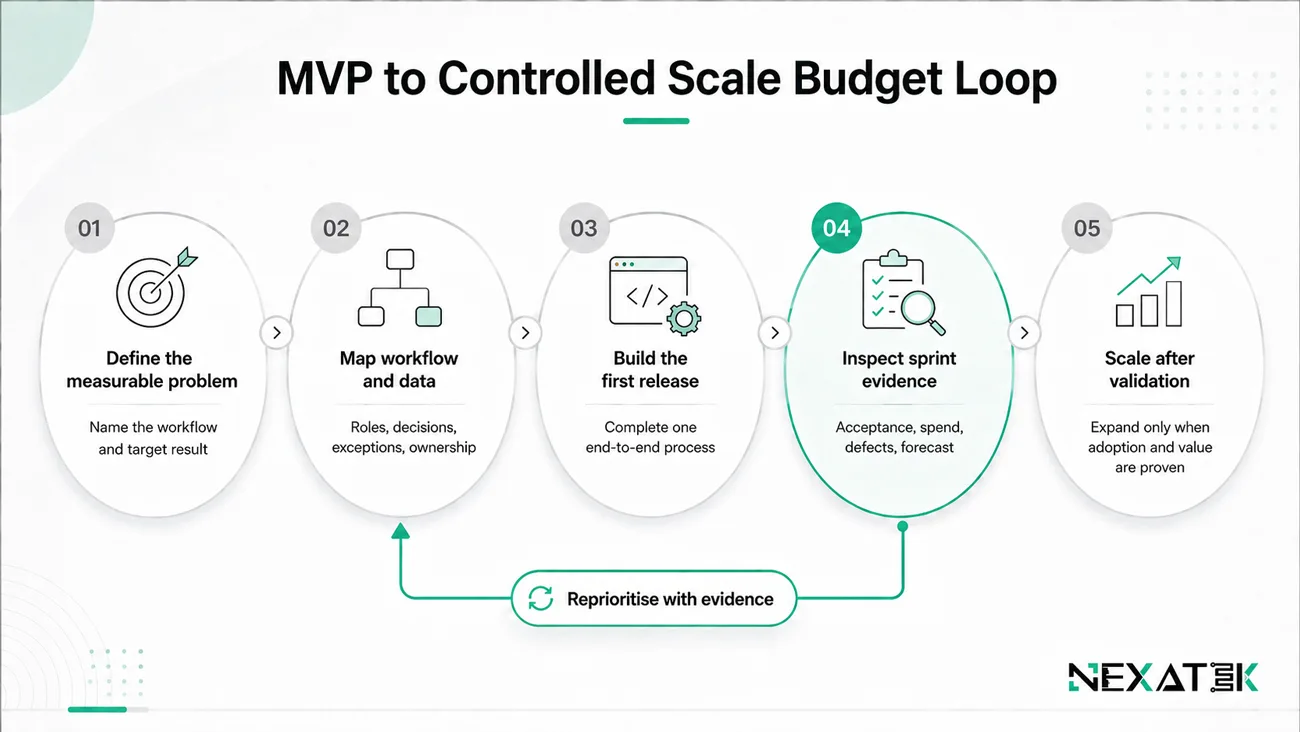
Cost control works through small decisions made throughout delivery. The organisation needs a measurable problem, a prioritised first release, sprint-level evidence, and a total-cost forecast that includes operation. A large contingency cannot compensate for weak ownership or slow decisions.
Prioritizing MVP Features
An MVP should prove the smallest complete workflow that creates measurable value. For an engineering firm, that could mean capturing one inspection result at source, validating it, routing it for review, and producing the required report from the same record. A partial collection of disconnected screens does not test the operating model.
Prioritisation should rank outcomes, not stakeholder requests. Keep features that are necessary to complete the target workflow, maintain data quality, and support adoption. Defer secondary dashboards, broad configuration, and low-frequency exceptions until the pilot generates evidence. Workflow automation and process optimisation should remove duplicate work before software accelerates it.
Agile Budget Control & Sprint Cost Visibility
Agile delivery improves budget control when it makes progress visible. Each sprint should report completed acceptance criteria, unresolved decisions, defects, actual spend, revised forecast, and the effect of backlog changes. A demonstration alone is not sufficient if the underlying data, tests, or deployment work remains incomplete.
Use decision gates. At the end of discovery, decide whether the problem is defined. After the prototype, decide whether users can complete the workflow. After the pilot, decide whether adoption and performance support scaling. This approach protects budget by allowing management to stop before uncertainty becomes sunk cost.
Reducing Technical Debt
Technical debt is the future cost created by shortcuts in architecture, testing, documentation, data structure, or security. Some debt is deliberate and acceptable for a pilot. Hidden debt is dangerous because it appears later as slow changes, recurring defects, and dependence on individual developers.
Track debt as a managed backlog with business impact. Reserve capacity for high-risk items and require architecture decisions, automated tests, and operating documentation for critical modules. A low first-release price that leaves an unmaintainable system is not a saving.
Ongoing Support vs. Development Budgeting
Separate run cost from change cost. Run cost covers monitoring, incident response, backups, security updates, platform administration, and user support. Change cost covers new features, integrations, revised rules, and improvements. Both should have owners, service expectations,
and an annual planning process.
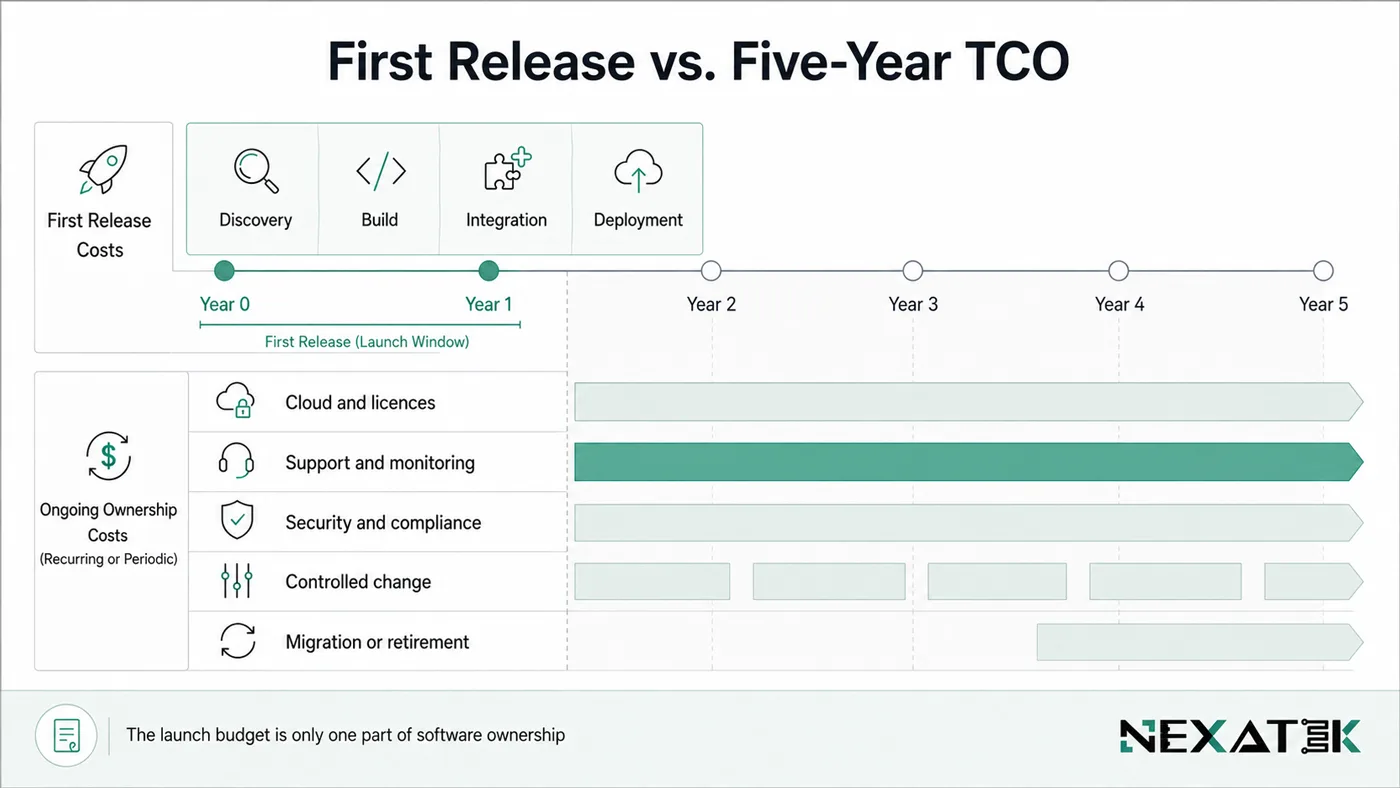
A practical starting hypothesis is to reserve 15% to 25% of initial build cost per year for active support and controlled evolution, then replace that assumption with actual demand data. Systems with complex integrations, frequent regulatory change, or 24-hour operations may need more. The five-year model should also include cloud, licences, data growth, model usage, training, and eventual migration or retirement.
Decision Note
Budget approval should cover the first release and the operating model that follows it. A system without named ownership, support capacity, cost monitoring, and a controlled change process is unfinished even when the code is deployed.
How Emerging Tech Affects Custom Software Development Cost in 2026?
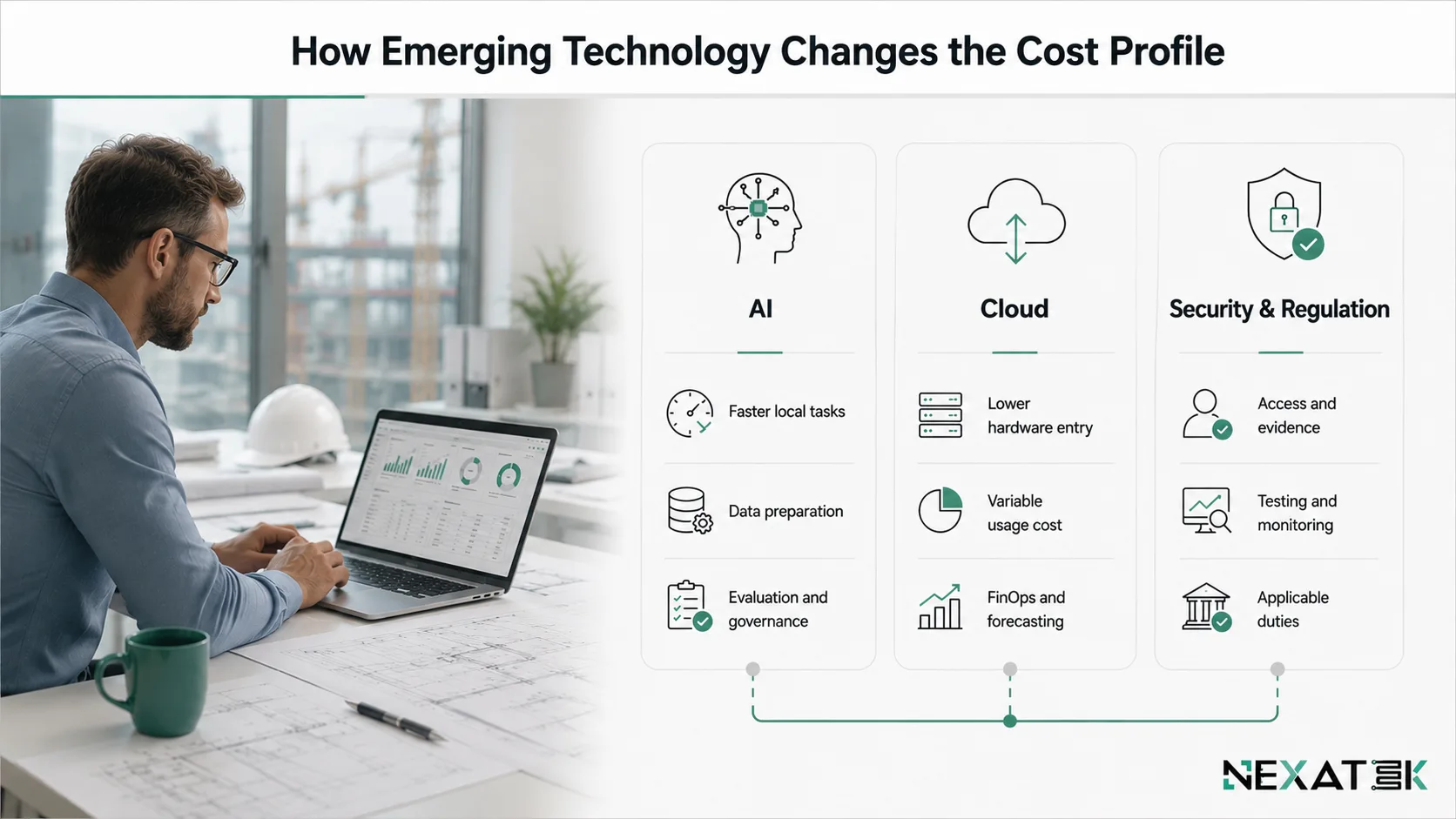
Emerging technology changes where the budget is spent. AI can reduce effort in some coding, documentation, and testing tasks, while adding
evaluation and governance. Cloud services reduce hardware procurement but create variable operating costs. Regulation and cyber risk increase the evidence required around data, decisions, and access.
AI / Generative Code Impact on Development Speed
Generative coding tools can accelerate local tasks such as boilerplate, test creation, explanation, and refactoring. Their effect on the full delivery timeline depends on requirements quality, architecture, review discipline, and deployment practice. Faster code production has limited value when teams are waiting for data decisions or rewriting unstable interfaces.
DORA’s 2025 findings show the balance. AI adoption was associated with higher throughput and product performance, but still had a negative relationship with software delivery stability. Budget models should assume productivity gains selectively, then retain peer review, automated testing, security scanning, and architecture control. AI reduces some effort; It does not remove accountability.
Cloud-Native Architectures – OpEx vs. CapEx
Cloud-native architecture replaces much upfront hardware spending with usage-based operating expense. It can improve scalability and deployment speed, but it also makes cost behaviour dependent on traffic, storage, observability, data transfer, model calls, and configuration. An estimate should include baseline, expected, and stress scenarios rather than one monthly number.
The State of FinOps 2026 reports that 98% of respondents now manage AI spend, 90% manage SaaS or plan to, and 28% are beginning to include labour costs in their FinOps scope. Cost allocation, forecasting, and governance therefore belong in the architecture from the first release.
Cybersecurity & Regulatory Weight
Security and regulation increasingly shape software scope. Engineering platforms may hold commercially sensitive designs, client records, infrastructure data, or AI-generated recommendations. The budget must cover identity, least-privilege access, secure development, logging, recovery, vulnerability management, supplier controls, and evidence for client or authority review.
European AI obligations have also continued to change. The European Commission reported that the AI Omnibus entered into force on 27 July 2026 with extended timelines and administrative simplification. Teams should not estimate compliance from a generic checklist. They need to classify the system, confirm applicable dates and duties, and preserve budget for legal and technical review where the use case requires it.
💡 Key Takeaways
The most important points to remember when evaluating custom software development costs:
Cost depends on complexity, not screen count.
Custom software pricing is driven by engineering logic, data condition, integrations, quality assurance, and operational responsibility.
Validate before building at scale.
Discovery phases and prototype validation help reduce expensive uncertainty before full development begins.
Planning ranges are not fixed market prices.
The $25,000 to $1,200,000+ cost scenarios in this guide are illustrative examples designed for planning, not universal software pricing.
Select a pricing model based on certainty.
The right engagement model should match project scope clarity, flexibility requirements, and the buyer’s need for transparency and evidence.
AI improves speed, not responsibility.
AI can increase development throughput, but evaluation, testing, security, and governance remain essential parts of software delivery.
Consider the full cost of ownership.
A board-ready budget should include the initial release, annual operation, controlled changes, and five-year total cost of ownership.
Conclusion
A credible 2026 software budget is a model of the operating system the organisation intends to create. It shows which engineering workflow will change, who owns the data, how systems connect, what quality evidence is required, and what happens after launch. That level of clarity gives management a better basis for comparing proposals than one total figure.
Start with one measurable workflow and a realistic data inventory. Use discovery to expose integration, governance, and adoption risk. Then fund a first release that can be tested in real work before scaling. This sequence does not guarantee a low budget. It produces a budget that can be explained, controlled, and connected to operational value.
Build a software budget around engineering reality
NEXATEK combines civil engineering workflow analysis with software,
data, UX, and project delivery expertise. The result is a scoped first
release, a clearer total-cost model, and a delivery route that protects
traceability and future change.
Frequently Asked Questions
What influences the cost of custom software development most in 2026?
Custom Software Development Cost in 2026 is mainly influenced by software complexity, required features, integrations, scalability needs, and technology choices. For infrastructure and engineering firms, factors such as BIM integration, cloud systems, mobile applications, data management, and workflow automation can significantly impact the final investment.
How should infrastructure firms estimate ongoing maintenance costs?
Infrastructure firms should estimate maintenance costs based on software complexity, user volume, cloud infrastructure, security requirements, integrations, and future development needs. A realistic maintenance plan should include updates, performance improvements, technical support, and continuous optimization to keep the software aligned with changing project requirements.
Is custom software more cost-effective than off-the-shelf tools long-term?
Custom software can be more cost-effective in the long term when it addresses specific business challenges and improves operational efficiency. While off-the-shelf tools may have lower initial costs, custom solutions can reduce manual processes, eliminate unnecessary features, connect existing systems, and provide greater flexibility as the company grows.
How do AI and automation impact development cost and scheduling?
AI and automation can increase initial development complexity, but they often create long-term value by reducing repetitive tasks, improving workflows, and accelerating decision-making. When integrated properly, AI-powered features can help engineering firms improve productivity, reduce operational costs, and build more intelligent software solutions.
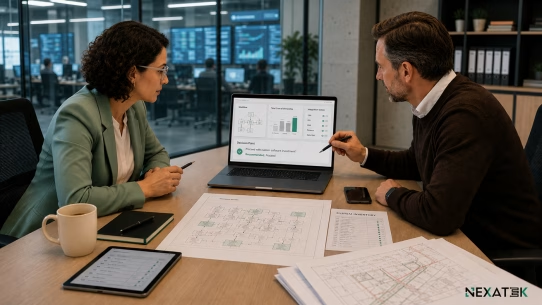

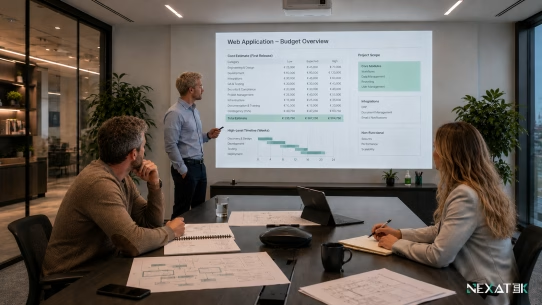

Clear requirements at the start can prevent expensive changes later in the development process!
A good reminder that software cost is not just about the number of features. Workflow complexity, integrations, data quality, and long-term maintenance can have a much bigger impact on the final budget.